
Record 01
Sources checkedDrua — the double-hulled sailing canoe
Pre-contact – late 19th century Watercraft
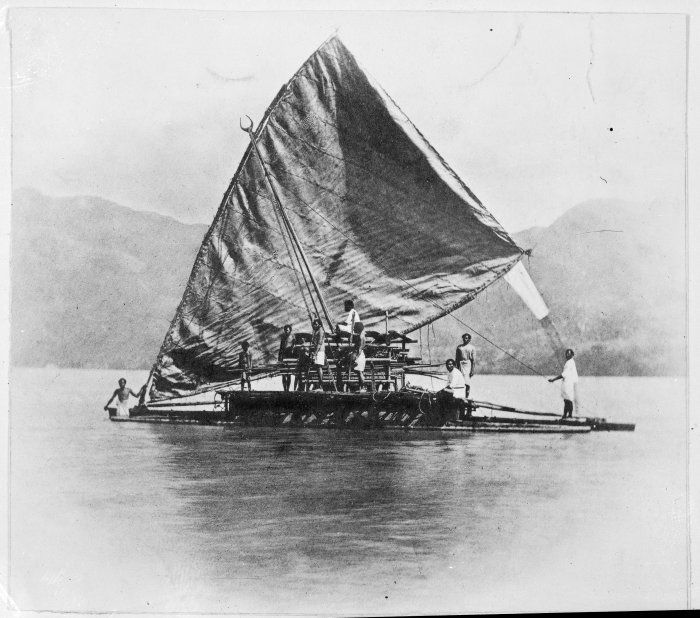
Fiji's ocean-going double-hulled canoe. Plank-built without a single nail and sewn with coconut sennit, the drua carried people, livestock and cargo across the Pacific.
Read the full record
The drua was among the largest ocean-going vessels built in the Pacific before European contact. Its hulls were not dugouts but plank-built: sections of vesi hardwood shaped and sewn edge to edge with magimagi, cord plaited from coconut husk fibre. No metal was used anywhere in the hull. The two hulls were deliberately unequal, the smaller one always kept to windward, and both ends of each hull were identical. A drua did not tack; it shunted, so the bow became the stern and the huge triangular pandanus-mat sail was shifted to the other end. Large drua reached roughly 30 metres and carried well over a hundred people plus livestock and cargo, with contemporary accounts reporting speeds near fifteen knots. Large nineteenth-century drua do not survive as intact hulls. Ratu Finau, held by the Fiji Museum, is a later 1913 Fulaga-built canoe measuring about 13.4 metres.
Why it matters
The drua proves Fijians were engineers as well as navigators. It places Fiji at the centre of Pacific maritime history rather than at its edge, while Uto ni Yalo's work from Vuda Marina supports a new generation learning traditional sailing and ocean stewardship.
Cultural protocol
Drua were waqa tabu — sacred, chiefly vessels, some buried with the chiefs who owned them. Accounts of their launching and of canoe warfare circulate in sensationalised colonial-era forms; present them factually and with the dignity owed to chiefly property.
Sources
- 1.Te Papa Tongarewa — Drua, double-hulled voyaging canoe of Fiji —
- 2.Encyclopedia of Crafts in WCC-Asia Pacific Region — Drua —
- 3.Fiji Museum — Our Exhibitions: Ratu Finau —
- 4.Fiji Times — 2 years to build a giant: Ratu Finau dimensions and construction —
- 5.Uto ni Yalo Trust — Vuda Marina partnership and traditional sailing outreach —