
BEFORE 1900
The drua, Fiji’s great double canoe
What we know
- The drua is a Fijian double-hulled sailing canoe: two hulls of unequal length joined by a raised deck.
- Drua were sailed by shunting — the sail was carried from one end to the other, so either end could become the bow.
- The largest drua were among the biggest canoes built anywhere in the Pacific and could carry well over a hundred people.
- The drua Ratu Finau, the last of the old sea-going drua, is preserved at the Fiji Museum in Suva.
Words in this chapter
drua — this chapter is where the museum explains this word. See the whole glossary →
Pictures in this chapter
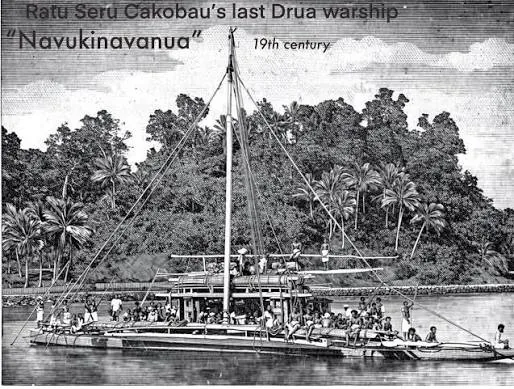 The drua Navukinavanua, described as Ratu Seru Cakobau’s last war canoe — 19th-century photograph
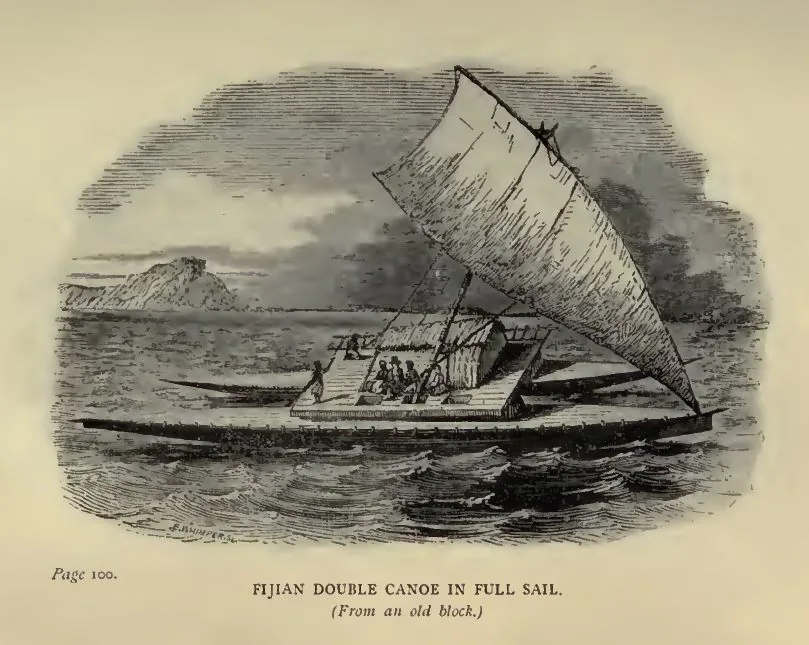 Fijian double canoe in full sail — 19th-century engraving “from an old block”
 By the mid-19th century some drua measured 30 metres in length and were capable of carrying over 100 men. (1856)
 Model of a Fijian double canoe (drua), Otago Museum
 Fijian druas (1913)
 Fijians on a drua (double-hulled canoe), 1800s
 Photograph of sailing canoe or "drua" in the Fiji Museum in Suva, Fiji. (1962)
 Edward Gennys Fanshawe, Double canoe off Moalu, Feejee Islands, Septr 26th 1849 (Fiji)
 Fijian double hulled canoe 1849
 A Fijian double canoe of the 19th century (published 1925)
 Fijian canoe, schematic diagram (1858)
 Fijian canoe, drawing (1858)
 Canoe of the people of "Balahou", Fiji — from Dumont d'Urville's voyage atlas (1842)
Sources
More in Voyagers and canoes
Tell the museum something
A memory, a correction, or a question. Nothing you send appears on the site. It goes to the museum’s own queue, a person reads it, and they decide. If you teach, know this place, or remember it, your correction is worth more than a compliment.
This chapter’s text is awaiting cultural and historical review. Pictures keep the credit and licence of the collection that holds them.