
CENTURIES OF EXCHANGE
Voyaging between Fiji, Tonga and Samoa
What we know
- Fiji, Tonga and Samoa were linked for centuries by canoe voyages carrying people, goods and marriages.
- The Lau Islands, with their hardwood vesi timber, were famous canoe-building centres, where Tongan and Samoan carpenters also worked.
- The Tongan double canoe (kalia) was developed from Fijian drua designs.
Words in this chapter
kalia — this chapter is where the museum explains this word. See the whole glossary →
Pictures in this chapter
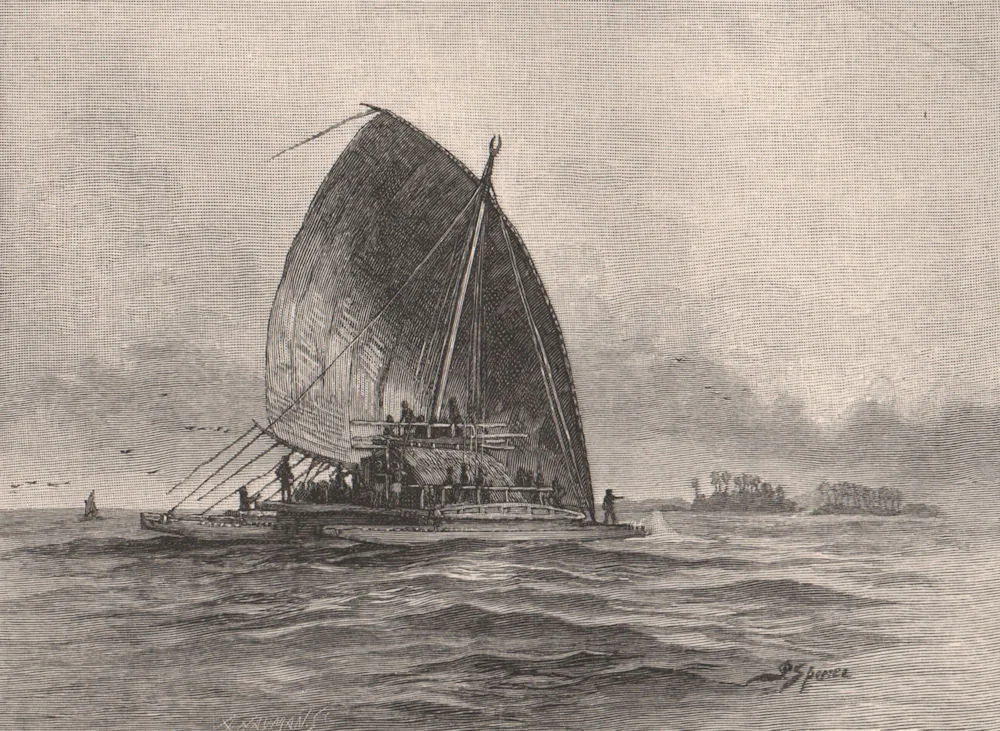 A Fijian double canoe under sail near low islands — 19th-century engraving
 Tupaia's chart of the islands surrounding Tahiti in Oceania (1769)
 Polynesian triangle stretching from New Zealand in the south to Easter Island in the east and Hawaii in the north. (2010)
 A photograph of a recreation of the star compass of Mau Piailug depicted with shells on sand, with Satawalese (See Trukic languages ) text labels, (2010)
 Hōkūle`a, a modern Hawaiian wa'a kaulua or voyaging canoe, sailing off Honolulu, photo taken from onboard the Chinese junk Princess Taiping , January 22, 2009.
 Large traditional double-hulled vaka in Rarotonga. (2010)
 Map of Oceania (2008)
 Mago Island, Lau Group, eastern Fiji (2000)
 NASA astronaut image of the Yagasa Cluster as part of the Lau Archipelago in Fiji (2001)
 NASA astronaut image of Moce Island with Karoni Islet and Na Potu Reef, Lau Archipelago, Fiji (2011)
 Naitaba (Lau-Islands) (1999)
 Water bottle, Lau - Otago Museum - Dunedin, NZ (2024)
Sources
More in Voyagers and canoes
Tell the museum something
A memory, a correction, or a question. Nothing you send appears on the site. It goes to the museum’s own queue, a person reads it, and they decide. If you teach, know this place, or remember it, your correction is worth more than a compliment.
This chapter’s text is awaiting cultural and historical review. Pictures keep the credit and licence of the collection that holds them.