
1860S TO 1911
Plantations and the labour trade
What we know
- Cotton planting boomed in the 1860s, when the American Civil War cut supplies.
- Workers were recruited from Vanuatu and the Solomon Islands, often by deception or force — the trade known as blackbirding.
- Copra (dried coconut) also became a major plantation crop.
- Descendants of these labourers still live in Fiji today.
The story
Plantations depended on people as much as on land. Cotton, copra and later sugar production drew workers into commercial agriculture under unequal conditions.
Pacific Islanders were recruited from places including what are now Vanuatu and Solomon Islands. Some recruitment involved deception or force, often described as blackbirding. Their history is connected to, but distinct from, Indian indenture. Both belong in an account of Fiji’s colonial labour system.
Pictures in this chapter
 Vanuatuan recruits for sugar plantations in Australia, Vanuatu, c. (1910)
 Para (ship) South Sea Islanders, recruited for the Queensland cane fields, being carried in boats to the Para . (1894)
 Seizure of the blackbirding schooner Daphne and its cargo by the HMS Rosario in 1869.
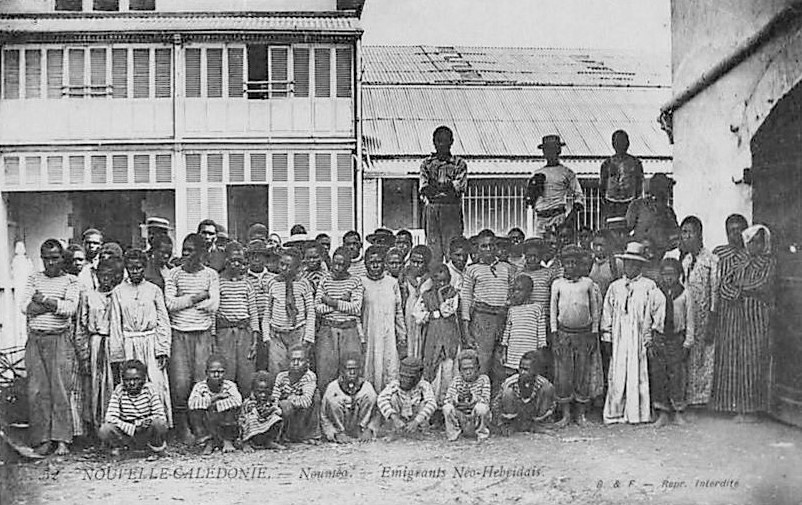 Ni-Vanuatu (New Hebridean) workers in Nouméa, New Caledonia
 Adolescent Pacific Island workers on the Lower Herbert River in the early 1870s
 Pacific Island labourers on a Queensland sugar plantation (1890s)
 Loading cane at a sugar plantation on Mago island, Fiji. (1884)
 Plantation on Ovalau, one of the Fiji islands.
 Taveuni, Fiji, abandoned copra plantation (2008)
 Men loading bags of copra and other crops onto an inter-island vessel at Lomaloma wharf, Vanua Balavu, for markets in Suva. (2014)
 Fiji. Landscape with view of bure (houses) and sugar cane plantation.
Sources
More in Colonial Roots
Tell the museum something
A memory, a correction, or a question. Nothing you send appears on the site. It goes to the museum’s own queue, a person reads it, and they decide. If you teach, know this place, or remember it, your correction is worth more than a compliment.
This chapter’s text is awaiting cultural and historical review. Pictures keep the credit and licence of the collection that holds them.